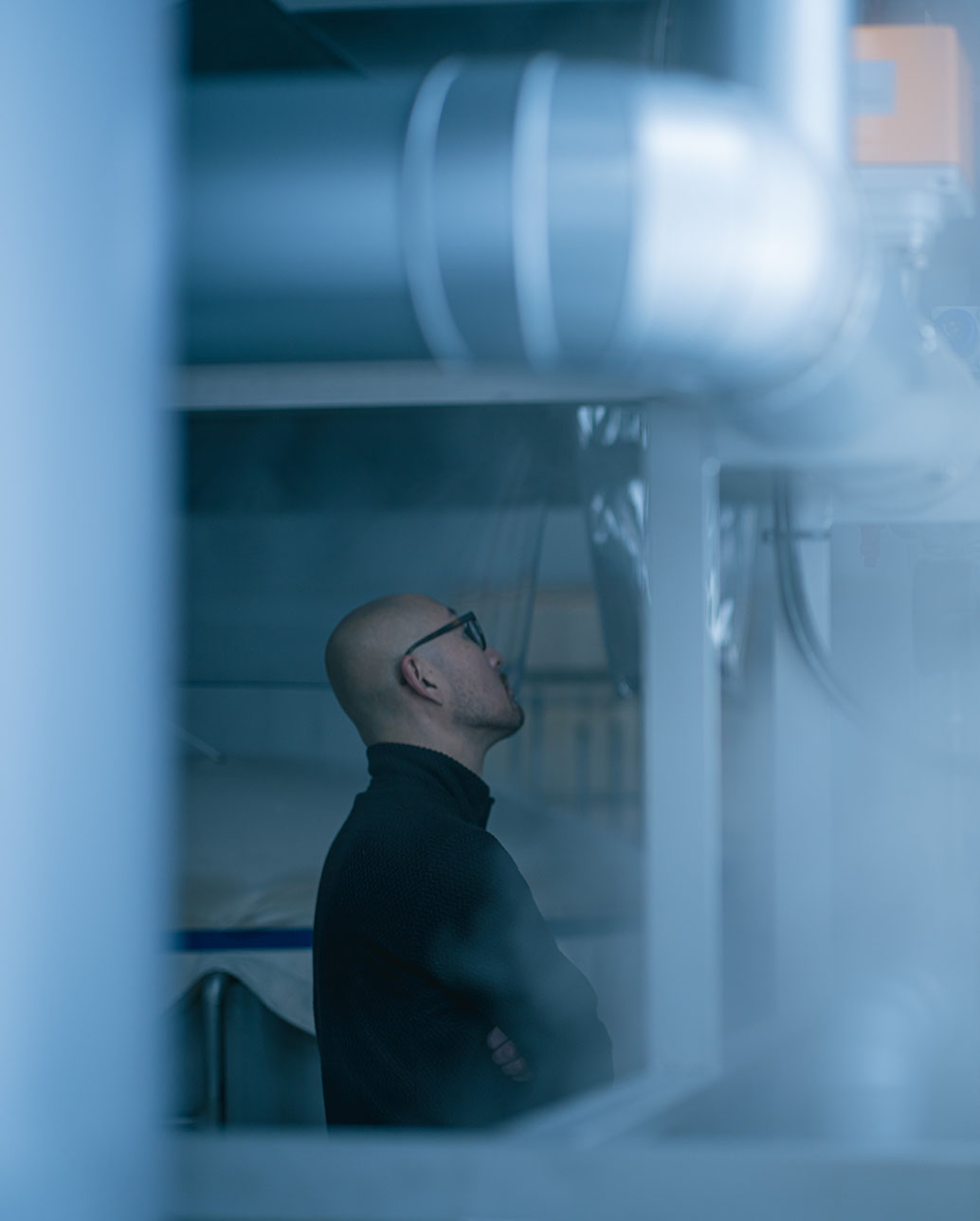
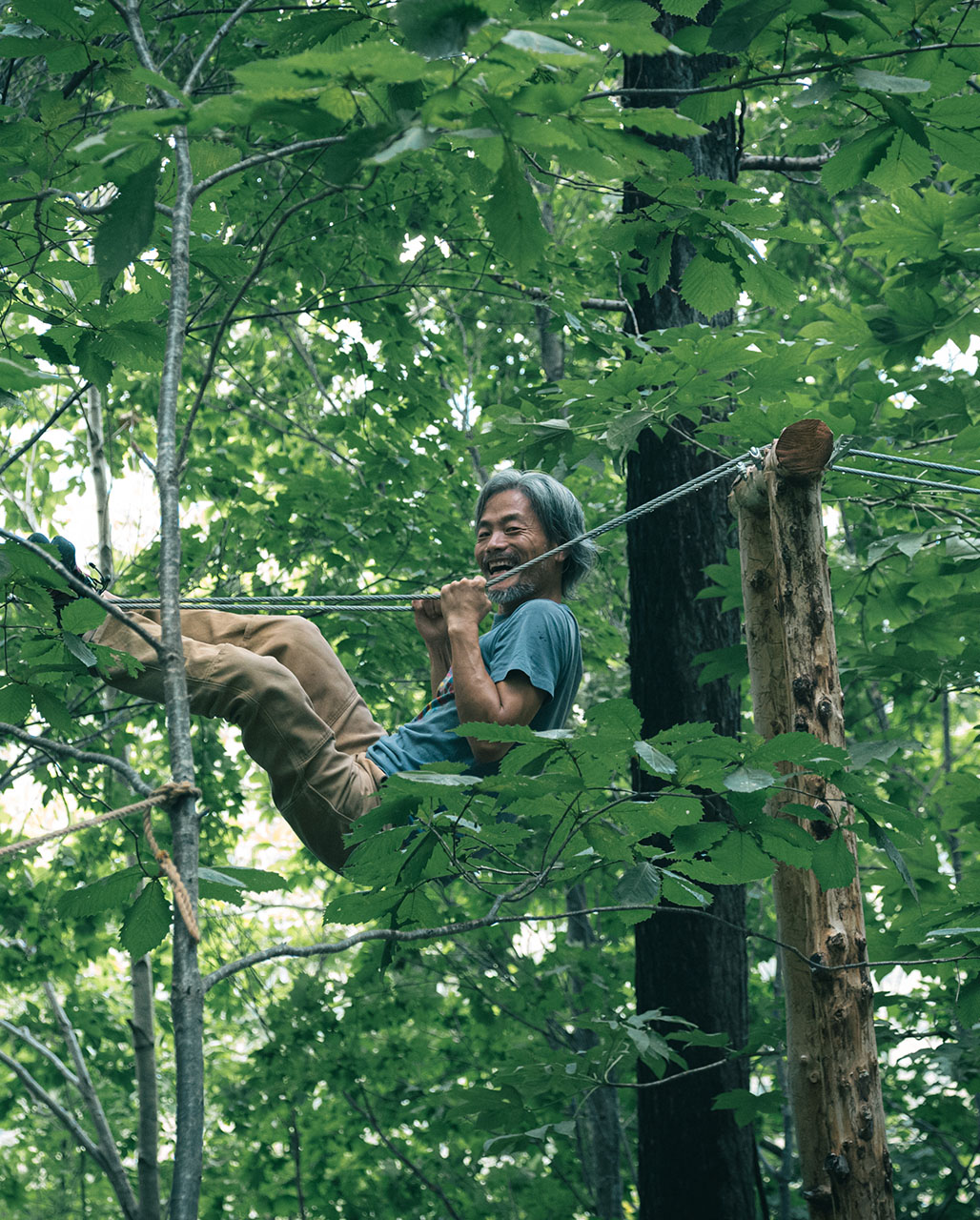
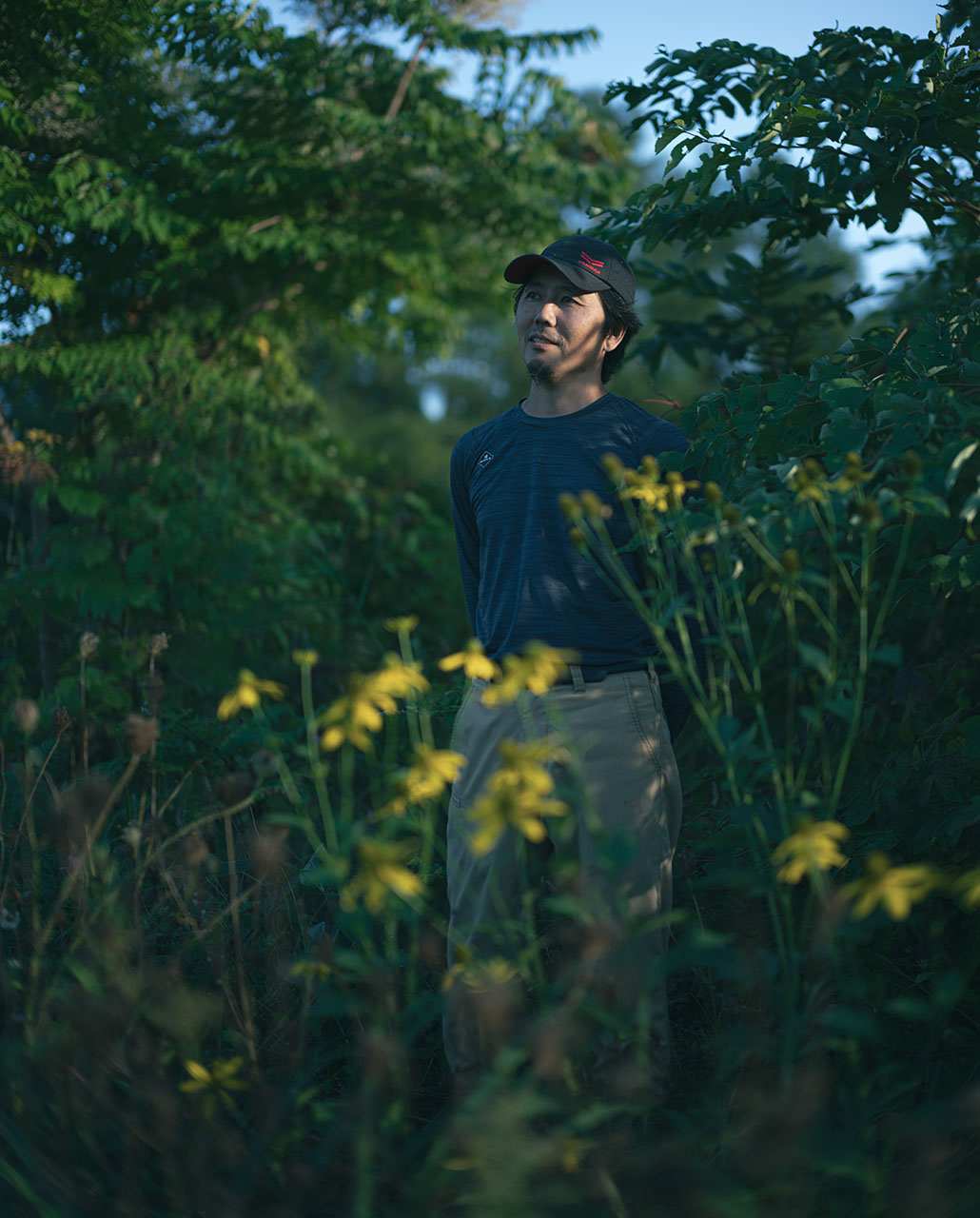
Mori No Brewery aims to craft sake inspired by the land of Rankoshi. This perspective resonates with Inoue, who leads the brand “Yukimushi WØRKS” in the town and creates wooden works using locally sourced Rankoshi timber. Through the meeting of Kitahara and Inoue, trees felled on the brewery grounds were given new life as furnishings and tableware.
Kitahara: I had always carried the idea of making use of what comes from the forest, so discovering that Mr. Inoue was working in the same town felt like a meaningful connection.
Inoue: It was around December 2023 when I first heard from Kitahara, and we went to visit the forest together. Deep inside, a stretch of healthy broadleaf trees continued on and on, and I remember thinking in astonishment, “What kind of place is this?!” Around that time, I learned that Kitahara was about to relocate to Rankoshi, so I quickly asked to visit his home in Hakushu as well. What matters most to me is visiting someone’s home and seeing with my own eyes the style of the house and the furniture – understanding how they live.
Working with Mori No Brewery has been a true joy for me, and I’ve become completely immersed in it. Asahikawa is the main hub for furniture makers and workshops, and it’s more than a 3.5 hour drive from Rankoshi. Even so, many facilities in the surrounding area end up purchasing furniture from Asahikawa. I myself sometimes have lumber sawn and kiln-dried at sawmills there. It’s frustrating, because in the past we were able to do both the sawing and drying locally – but that has become increasingly difficult.
In Japan’s furniture industry, imported woods are often used because they are easy to work with and offer consistent quality. But I value the sensibility of making things from local materials like the old neighborhood tofu shops that once existed in rural towns. What I aspire to be is a furniture maker who can guide you all the way back to the stump.

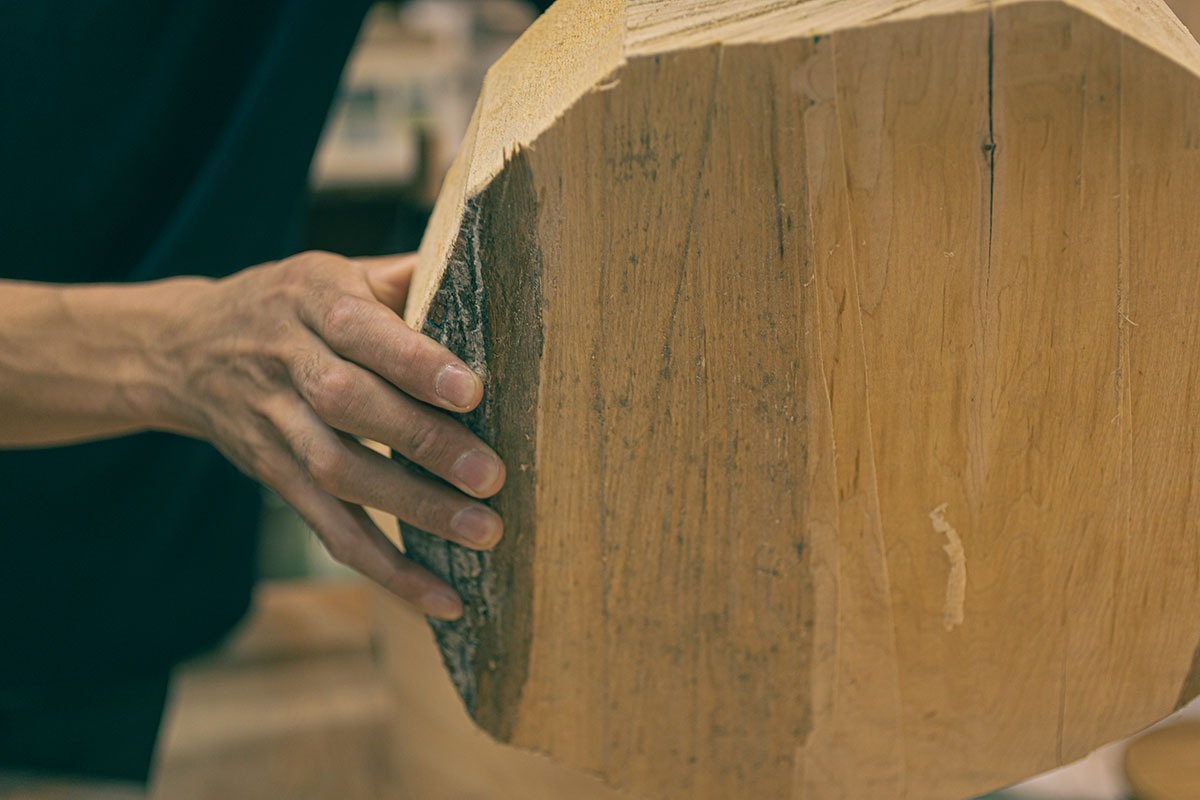
In the forest surrounding the brewery, they came across a fallen Monarch Birch tree. Woodcutter Jinnouchi assumed that the core would likely be rotten, but when he cut into it with a chainsaw, the timber proved to be unexpectedly sound. Inoue, who was there at the time, was equally surprised. The tree had completed its natural life cycle in the forest and showed no cracking. That Monarch Birch tree was reborn as a tasting counter – one that now stands out as a striking presence within the brewery space.
Inoue: This time, I was able to be involved from the very moment the trees were felled, which has made me feel an exceptionally strong attachment to every piece of timber. The monarch birch was both sawn and dried here in Rankoshi. And now, having been transformed, it returns to the forest once again. I can’t imagine a more fortunate fate for any piece of wood.
Kitahara: Tasting sake at a counter made from timber harvested on-site, while looking out over the brewery’s forest – this is a truly one-of-a-kind experience. Most of the fixtures inside the shop are works by Mr. Inoue himself, transforming the space into something akin to a gallery.
Inoue: From the very early stages of the brewery’s construction, Mr. Kitahara had a clear vision in mind, and I worked with the intention of bringing it as close to that vision as possible. I make a point of inviting my clients to the workshop many times, allowing them to see the work in progress. Once the wood is cut, there is no way to take it back. This is not merely custom-made furniture. I believe it is truly “bespoke” – a one-of-a-kind piece, created exclusively for a single client through deep and continuous dialogue.

He cuts the trees himself, mills the wood, and brings it all the way to finished furniture. It is rare for a woodworker to carry every stage of the process with his own hands. Inoue himself admits that from the standpoint of efficiency it hardly makes sense. And yet, there is a reason he deliberately chooses to work this way.
Inoue: At lumberyards, straight timber with flawless characteristics is classified as top-grade. It is easy to process, but to me, its grain feels almost too simple. What truly draws me in are pieces that lumberyards tend to overlook – wood that forks into 2 branches, for example. Why did it split partway through? Was the trunk broken by a typhoon, or shaped by the way sunlight fell? There must have been something there. The strength gained from enduring nature’s conditions is etched into the grain. This is proof that the tree once lived.
Kitahara: When I first encountered trees in the forest, I felt that those standing straight were the most beautiful. But through meeting Mr. Jinnouchi and Mr. Inoue, I learned to see the beauty of trees that bend and twist. In nature, no two things are ever the same. There is always some kind of distortion, somewhere. I came to realize that beauty lies precisely within that unevenness.
Just as the marks of a life are etched into wood, I believe that the way a brewer has lived is likewise reflected in the sake they create. Rather than a life that moves forward without resistance, it is a life shaped by repeated setbacks that seems to carry greater depth.
Inoue: I regularly make my way into the mountains, in both summer and winter. When I climb Mount Yōtei, I encounter Japanese white birches whose trunks and branches twist and bend in unexpected ways. When I begin my work after seeing those forms, the results are always especially good. As I carve the wood, I recall the way those branches curve on the mountain slopes. It is not about pushing my own expression onto the material. The natural form itself is already beautiful – I simply feel that I happened to be the one who carved it. If I were to stay shut away in my workshop all year round, I would probably lose sight of what it is I truly want to make.
Kitahara: That same sensibility carries over into sake brewing as well. In my previous work, I spent most of the year inside climate-controlled breweries, and I came to feel that shutting oneself away in a place where the seasons cannot be sensed is, in a way, inhuman. By coming into contact with nature, our human instincts are called back to life. I believe this is reflected in the act of brewing sake – and it appears just as clearly in works of wood.
Inoue: We hope that when people use furniture and vessels from Yukimushi WØRKS in their everyday lives, they will find themselves recalling the nature of this region – if only for a moment. This is not simply about selling objects. Through each piece we hope people can feel the story of how we engage with nature and the way we choose to approach it.


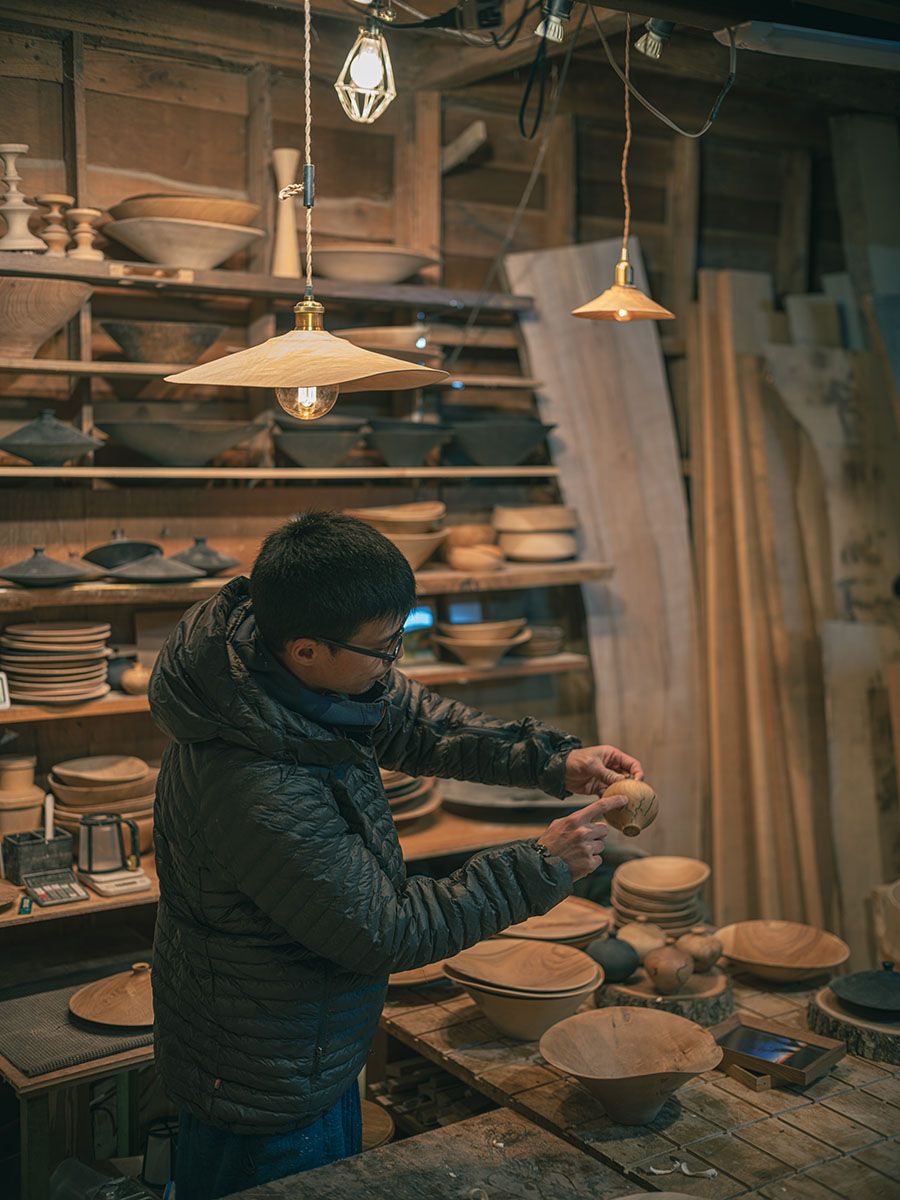
Born in Osaka in 1989, he spent his early childhood in Kobe before moving to the Netherlands and Denmark at the age of ten due to his parents’ work. After returning to Japan, he enrolled at a university in Shizuoka. Following graduation, he worked in the hotel industry while developing a deep passion for mountaineering. In 2013, he relocated to Niseko, where he worked as a mountain guide alongside employment at a furniture workshop. After later moving to Rankoshi, he founded Yukimushi WØRKS in 2022. Aside from learning the fundamentals at a furniture workshop, he is largely self-taught, creating his woodwork through a distinctive process of hands-on experimentation and continual trial and error with his tools.